Loading…
July Weather in Abqaiq Saudi Arabia
Daily high temperatures are around 113°F, rarely falling below 108°F or exceeding 119°F. The highest daily average high temperature is 114°F on July 18.
Daily low temperatures are around 85°F, rarely falling below 80°F or exceeding 90°F. The highest daily average low temperature is 86°F on July 26.
For reference, on July 16, the hottest day of the year, temperatures in Abqaiq typically range from 86°F to 114°F, while on January 13, the coldest day of the year, they range from 48°F to 69°F.
Average High and Low Temperature in July in Abqaiq
The figure below shows you a compact characterization of the hourly average temperatures for the quarter of the year centered on July. The horizontal axis is the day, the vertical axis is the hour of the day, and the color is the average temperature for that hour and day.
Average Hourly Temperature in July in Abqaiq
Needles, California, United States (8,122 miles away); Hermosillo, Mexico (8,433 miles); and Chingueṭṭi, Mauritania (3,921 miles) are the far-away foreign places with temperatures most similar to Abqaiq (view comparison).
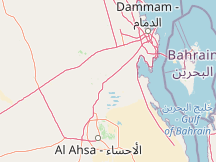

Compare Abqaiq to:
Clouds
The month of July in Abqaiq experiences very rapidly increasing cloud cover, with the percentage of time that the sky is overcast or mostly cloudy increasing from 23% to 42%. The highest chance of overcast or mostly cloudy conditions is 42% on July 30.
The clearest day of the month is July 1, with clear, mostly clear, or partly cloudy conditions 77% of the time.
For reference, on July 30, the cloudiest day of the year, the chance of overcast or mostly cloudy conditions is 42%, while on October 1, the clearest day of the year, the chance of clear, mostly clear, or partly cloudy skies is 93%.
Cloud Cover Categories in July in Abqaiq
Precipitation
Sun
Over the course of July in Abqaiq, the length of the day is gradually decreasing. From the start to the end of the month, the length of the day decreases by 23 minutes, implying an average daily decrease of 45 seconds, and weekly decrease of 5 minutes, 16 seconds.
The shortest day of the month is July 31, with 13 hours, 22 minutes of daylight and the longest day is July 1, with 13 hours, 44 minutes of daylight.
Hours of Daylight and Twilight in July in Abqaiq
The earliest sunrise of the month in Abqaiq is 4:53 AM on July 1 and the latest sunrise is 14 minutes later at 5:06 AM on July 31.
The latest sunset is 6:37 PM on July 3 and the earliest sunset is 9 minutes earlier at 6:28 PM on July 31.
Daylight saving time is not observed in Abqaiq during 2026.
For reference, on June 21, the longest day of the year, the Sun rises at 4:50 AM and sets 13 hours, 46 minutes later, at 6:36 PM, while on December 21, the shortest day of the year, it rises at 6:23 AM and sets 10 hours, 31 minutes later, at 4:54 PM.
Sunrise & Sunset with Twilight in July in Abqaiq
The figure below presents a compact representation of the sun's elevation (the angle of the sun above the horizon) and azimuth (its compass bearing) for every hour of every day in the reporting period. The horizontal axis is the day of the year and the vertical axis is the hour of the day. For a given day and hour of that day, the background color indicates the azimuth of the sun at that moment. The black isolines are contours of constant solar elevation.
Solar Elevation and Azimuth in July in Abqaiq
Moon
The figure below presents a compact representation of key lunar data for July 2026. The horizontal axis is the day, the vertical axis is the hour of the day, and the colored areas indicate when the moon is above the horizon. The vertical gray bars (new Moons) and blue bars (full Moons) indicate key Moon phases. The label associated with each bar indicates the date and time that the phase is obtained, and the companion time labels indicate the rise and set times of the Moon for the nearest time interval in which the moon is above the horizon.
Moon Rise, Set & Phases in July in Abqaiq
| Jul 2026 | Illumination | Moonrise | Moonset | Moonrise | Meridian Passing | Distance | |||||
|---|---|---|---|---|---|---|---|---|---|---|---|
| 1 |
|
99% | - | 5:47 AM | WSW | 7:56 PM | ESE | 12:31 AM | S | 251,010 mi | |
| 2 |
|
97% | - | 6:44 AM | WSW | 8:33 PM | ESE | 1:20 AM | S | 249,714 mi | |
| 3 |
|
92% | - | 7:40 AM | WSW | 9:07 PM | ESE | 2:06 AM | S | 248,028 mi | |
| 4 |
|
86% | - | 8:35 AM | WSW | 9:39 PM | E | 2:51 AM | S | 245,955 mi | |
| 5 |
|
78% | - | 9:30 AM | W | 10:09 PM | E | 3:34 AM | S | 243,498 mi | |
| 6 |
|
68% | - | 10:25 AM | W | 10:40 PM | E | 4:16 AM | S | 240,683 mi | |
| 7 |
|
50% | - | 11:22 AM | W | 11:13 PM | E | 4:59 AM | S | 237,573 mi | |
| 8 |
|
47% | - | 12:21 PM | WNW | 11:49 PM | ENE | 5:45 AM | S | 234,283 mi | |
| 9 |
|
35% | - | 1:25 PM | WNW | - | 6:34 AM | S | 230,993 mi | ||
| 10 |
|
24% | 12:30 AM | ENE | 2:33 PM | WNW | - | 7:28 AM | S | 227,946 mi | |
| 11 |
|
15% | 1:19 AM | ENE | 3:43 PM | WNW | - | 8:29 AM | N | 225,431 mi | |
| 12 |
|
7% | 2:17 AM | ENE | 4:53 PM | WNW | - | 9:34 AM | N | 223,749 mi | |
| 13 |
|
2% | 3:23 AM | ENE | 5:57 PM | WNW | - | 10:41 AM | N | 223,143 mi | |
| 14 |
|
0% | 4:34 AM | ENE | 6:53 PM | WNW | - | 11:46 AM | S | 223,742 mi | |
| 15 |
|
1% | 5:46 AM | ENE | 7:41 PM | WNW | - | 12:47 PM | S | 225,515 mi | |
| 16 |
|
6% | 6:55 AM | ENE | 8:22 PM | WNW | - | 1:41 PM | S | 228,284 mi | |
| 17 |
|
13% | 8:00 AM | ENE | 8:57 PM | W | - | 2:31 PM | S | 231,767 mi | |
| 18 |
|
21% | 9:01 AM | E | 9:30 PM | W | - | 3:17 PM | S | 235,626 mi | |
| 19 |
|
31% | 9:58 AM | E | 10:01 PM | W | - | 4:01 PM | S | 239,528 mi | |
| 20 |
|
41% | 10:54 AM | E | 10:33 PM | WSW | - | 4:44 PM | S | 243,178 mi | |
| 21 |
|
50% | 11:50 AM | ESE | 11:06 PM | WSW | - | 5:28 PM | S | 246,344 mi | |
| 22 |
|
62% | 12:45 PM | ESE | 11:41 PM | WSW | - | 6:13 PM | S | 248,864 mi | |
| 23 |
|
71% | 1:41 PM | ESE | - | - | 7:00 PM | S | 250,652 mi | ||
| 24 |
|
79% | - | 12:20 AM | WSW | 2:37 PM | ESE | 7:50 PM | S | 251,684 mi | |
| 25 |
|
87% | - | 1:04 AM | WSW | 3:31 PM | ESE | 8:42 PM | S | 251,996 mi | |
| 26 |
|
93% | - | 1:52 AM | WSW | 4:23 PM | ESE | 9:34 PM | S | 251,665 mi | |
| 27 |
|
97% | - | 2:45 AM | WSW | 5:11 PM | ESE | 10:26 PM | S | 250,793 mi | |
| 28 |
|
99% | - | 3:41 AM | WSW | 5:55 PM | ESE | 11:16 PM | S | 249,490 mi | |
| 29 |
|
100% | - | 4:37 AM | WSW | 6:34 PM | ESE | - | - | ||
| 30 |
|
100% | - | 5:34 AM | WSW | 7:09 PM | ESE | 12:04 AM | S | 247,859 mi | |
| 31 |
|
98% | - | 6:30 AM | WSW | 7:41 PM | ESE | 12:49 AM | S | 245,982 mi | |
Humidity
We base the humidity comfort level on the dew point, as it determines whether perspiration will evaporate from the skin, thereby cooling the body. Lower dew points feel drier and higher dew points feel more humid. Unlike temperature, which typically varies significantly between night and day, dew point tends to change more slowly, so while the temperature may drop at night, a muggy day is typically followed by a muggy night.
The chance that a given day will be muggy in Abqaiq is rapidly increasing during July, rising from 4% to 22% over the course of the month.
For reference, on August 20, the muggiest day of the year, there are muggy conditions 30% of the time, while on January 26, the least muggy day of the year, there are muggy conditions 0% of the time.
Humidity Comfort Levels in July in Abqaiq
Wind
This section discusses the wide-area hourly average wind vector (speed and direction) at 10 meters above the ground. The wind experienced at any given location is highly dependent on local topography and other factors, and instantaneous wind speed and direction vary more widely than hourly averages.
The average hourly wind speed in Abqaiq is decreasing during July, decreasing from 11.3 miles per hour to 9.7 miles per hour over the course of the month.
For reference, on June 21, the windiest day of the year, the daily average wind speed is 11.4 miles per hour, while on October 5, the calmest day of the year, the daily average wind speed is 7.6 miles per hour.
Average Wind Speed in July in Abqaiq
The hourly average wind direction in Abqaiq throughout July is predominantly from the north, with a peak proportion of 70% on July 3.
Wind Direction in July in Abqaiq
Water Temperature
Abqaiq is located near a large body of water (e.g., ocean, sea, or large lake). This section reports on the wide-area average surface temperature of that water.
The average surface water temperature in Abqaiq is increasing during July, rising by 4°F, from 87°F to 91°F, over the course of the month.
Average Water Temperature in July in Abqaiq
Growing Season
Definitions of the growing season vary throughout the world, but for the purposes of this report, we define it as the longest continuous period of non-freezing temperatures (≥ 32°F) in the year (the calendar year in the Northern Hemisphere, or from July 1 until June 30 in the Southern Hemisphere).
Temperatures in Abqaiq are sufficiently warm year round that it is not entirely meaningful to discuss the growing season in these terms. We nevertheless include the chart below as an illustration of the distribution of temperatures experienced throughout the year.
Time Spent in Various Temperature Bands and the Growing Season in July in Abqaiq
Growing degree days are a measure of yearly heat accumulation used to predict plant and animal development, and defined as the integral of warmth above a base temperature, discarding any excess above a maximum temperature. In this report, we use a base of 50°F and a cap of 86°F.
The average accumulated growing degree days in Abqaiq are very rapidly increasing during July, increasing by 1,073°F, from 4,244°F to 5,317°F, over the course of the month.
Growing Degree Days in July in Abqaiq
Solar Energy
This section discusses the total daily incident shortwave solar energy reaching the surface of the ground over a wide area, taking full account of seasonal variations in the length of the day, the elevation of the Sun above the horizon, and absorption by clouds and other atmospheric constituents. Shortwave radiation includes visible light and ultraviolet radiation.
The average daily incident shortwave solar energy in Abqaiq is essentially constant during July, remaining within 0.2 kWh of 7.7 kWh throughout.
Average Daily Incident Shortwave Solar Energy in July in Abqaiq
Topography
For the purposes of this report, the geographical coordinates of Abqaiq are 25.937 deg latitude, 49.678 deg longitude, and 338 ft elevation.
The topography within 2 miles of Abqaiq contains only modest variations in elevation, with a maximum elevation change of 154 feet and an average elevation above sea level of 299 feet. Within 10 miles also contains only modest variations in elevation (443 feet). Within 50 miles contains only modest variations in elevation (1,270 feet).
The area within 2 miles of Abqaiq is covered by bare soil (96%), within 10 miles by bare soil (99%), and within 50 miles by bare soil (83%) and water (13%).
Data Sources
This report illustrates the typical weather in Abqaiq, based on a statistical analysis of historical hourly weather reports and model reconstructions from January 1, 1980 to December 31, 2016.
Temperature and Dew Point
There are 2 weather stations near enough to contribute to our estimation of the temperature and dew point in Abqaiq.
For each station, the records are corrected for the elevation difference between that station and Abqaiq according to the International Standard Atmosphere , and by the relative change present in the MERRA-2 satellite-era reanalysis between the two locations.
The estimated value at Abqaiq is computed as the weighted average of the individual contributions from each station, with weights proportional to the inverse of the distance between Abqaiq and a given station.
The stations contributing to this reconstruction are:
- King Abdulaziz Air Base (OEDR, 58%, 37 mi, northeast, -256 ft elevation change)
- Al Ahsa Airport (OEAH, 42%, 47 mi, south, 249 ft elevation change)

To get a sense of how much these sources agree with each other, you can view a comparison of Abqaiq and the stations that contribute to our estimates of its temperature history and climate. Please note that each source's contribution is adjusted for elevation and the relative change present in the MERRA-2 data.
Other Data
All data relating to the Sun's position (e.g., sunrise and sunset) are computed using astronomical formulas from the book, Astronomical Algorithms 2nd Edition , by Jean Meeus.
All other weather data, including cloud cover, precipitation, wind speed and direction, and solar flux, come from NASA's MERRA-2 Modern-Era Retrospective Analysis . This reanalysis combines a variety of wide-area measurements in a state-of-the-art global meteorological model to reconstruct the hourly history of weather throughout the world on a 50-kilometer grid.
Land Use data comes from the Global Land Cover SHARE database , published by the Food and Agriculture Organization of the United Nations.
Elevation data comes from the Shuttle Radar Topography Mission (SRTM) , published by NASA's Jet Propulsion Laboratory.
Names, locations, and time zones of places and some airports come from the GeoNames Geographical Database .
Time zones for airports and weather stations are provided by AskGeo.com .
Maps are © OpenStreetMap contributors.
Disclaimer
The information on this site is provided as is, without any assurances as to its accuracy or suitability for any purpose. Weather data is prone to errors, outages, and other defects. We assume no responsibility for any decisions made on the basis of the content presented on this site.
We draw particular cautious attention to our reliance on the MERRA-2 model-based reconstructions for a number of important data series. While having the tremendous advantages of temporal and spatial completeness, these reconstructions: (1) are based on computer models that may have model-based errors, (2) are coarsely sampled on a 50 km grid and are therefore unable to reconstruct the local variations of many microclimates, and (3) have particular difficulty with the weather in some coastal areas, especially small islands.
We further caution that our travel scores are only as good as the data that underpin them, that weather conditions at any given location and time are unpredictable and variable, and that the definition of the scores reflects a particular set of preferences that may not agree with those of any particular reader.
Please review our full terms contained on our Terms of Service page.

You're permitted to use this graph as long as you provide prominent attribution with a link back close to the use of the graph. For example: © WeatherSpark.com
For print usage, please acquire a license.